


- Home
- Vertical

- Products
- Company
- Support


Difference Between Home Extension Loan and Home Loan Extension
Published:
02nd February, 2026
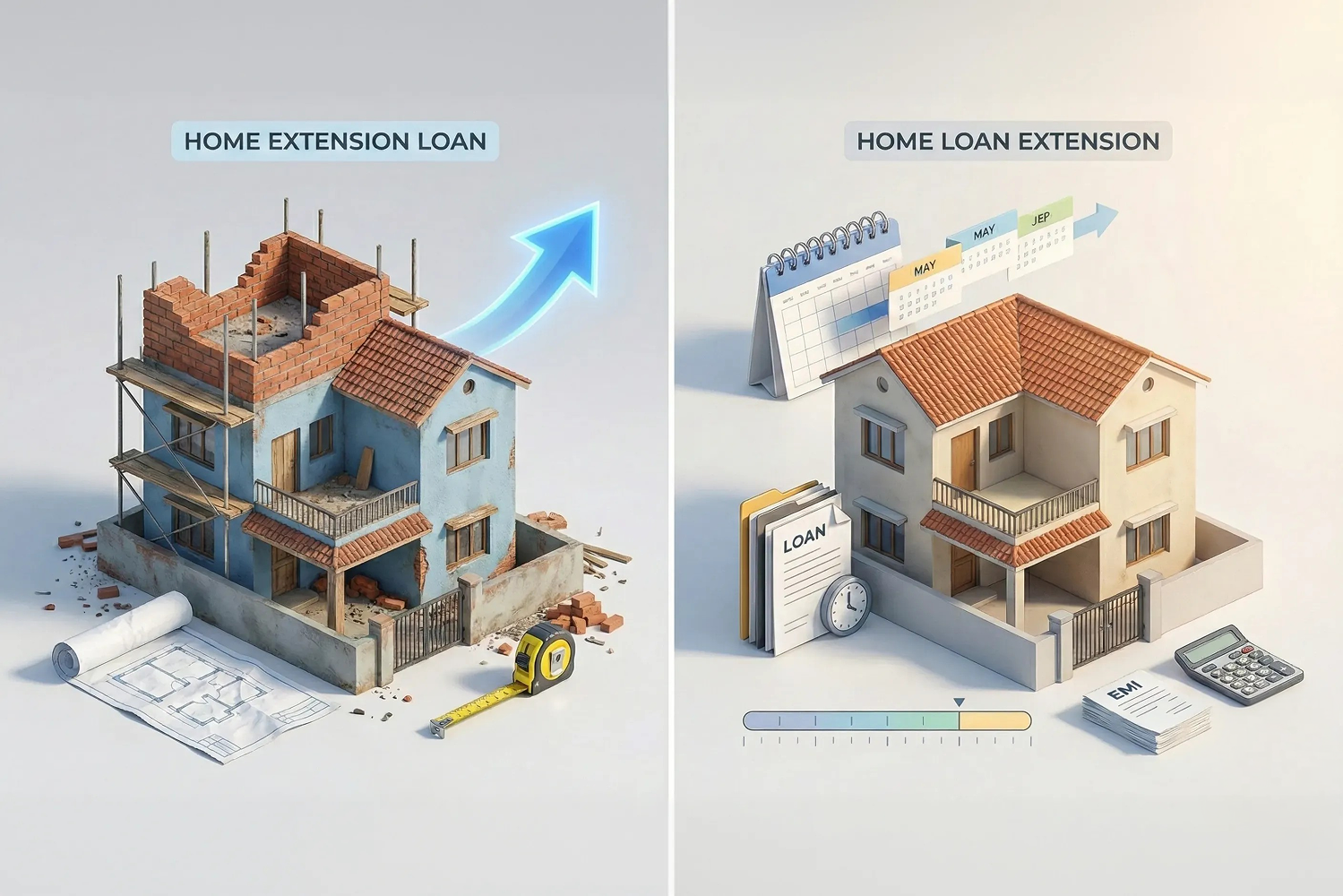
When you first buy a house, it often feels perfect. But as families grow, needs change. You might suddenly realize you need an extra bedroom for a new child, a dedicated home office, or a second floor to accommodate elderly parents. In the world of finance, there are two terms that sound remarkably similar but serve entirely different purposes: Home Extension Loan and Home Loan Extension.
While they share most of the same words, confusing the two can lead to significant financial planning errors. One helps you add physical square footage to your property, while the other is a modification of your loan’s repayment timeline.
This 2000-word guide will dismantle the confusion, providing a clear comparison of both options, their eligibility criteria, tax implications, and how to decide which one fits your current life stage. Whether you are a business owner looking for a Business Loan to fund an office expansion or a homeowner wanting to grow your living space, understanding these nuances is the first step toward smart asset management.
Part 1: What is a Home Extension Loan?
When you first buy a house, it often feels perfect. But as families grow, needs change. You might suddenly realize you need an extra bedroom for a new child, a dedicated home office, or a second floor to accommodate elderly parents. In the world of finance, there are two terms that sound remarkably similar but serve entirely different purposes: Home Extension Loan and Home Loan Extension.
While they share most of the same words, confusing the two can lead to significant financial planning errors. One helps you add physical square footage to your property, while the other is a modification of your loan’s repayment timeline.
This 2000-word guide will dismantle the confusion, providing a clear comparison of both options, their eligibility criteria, tax implications, and how to decide which one fits your current life stage. Whether you are a business owner looking for a Business Loan to fund an office expansion or a homeowner wanting to grow your living space, understanding these nuances is the first step toward smart asset management.
A Home Extension Loan is a specific type of credit facility designed for homeowners who want to physically expand their existing house. It is often categorized under “Home Improvement Loans” but is structurally distinct because it involves civil construction and the addition of new built-up area.
Core Purpose
The primary goal is to increase the living space of your property. Common uses include:
- Adding a new bedroom or a guest wing.
- Enclosing a balcony to create a study.
- Constructing an additional floor (vertical expansion).
- Extending the kitchen or adding a new bathroom.
Key Features
- Security: It is a secured loan where your property acts as collateral.
- Loan Amount: Lenders typically provide 75% to 90% of the construction estimate provided by an architect or civil engineer.
- Disbursement: Unlike a personal loan, the funds are usually disbursed in stages (tranches) based on the progress of the construction.
- Tenure: These loans offer long tenures, usually up to 20 years, making the EMIs affordable.
Part 2: What is a Home Loan Extension?
A Home Loan Extension (also known as a Loan Tenure Extension) has nothing to do with bricks and mortar. It is a purely financial arrangement where the borrower and the lender agree to increase the “tenure” or the time period of the existing Home Loan.
Core Purpose
The goal is to reduce financial pressure. By extending the tenure, you spread the remaining principal over a longer period, which results in a lower monthly EMI. This is often sought when:
- The borrower faces a sudden drop in income.
- Interest rates rise significantly (in floating-rate loans), and the borrower wants to keep the EMI constant.
- The borrower wants to free up monthly cash flow to invest in other areas, such as a Small Business Loan for a startup.
Key Features
- No New Capital: You do not receive extra money in your bank account; only the repayment schedule changes.
- Total Interest Cost: While the EMI drops, the total interest paid over the life of the loan increases significantly because you are in debt for a longer time.
- Age Limit: Lenders usually won’t extend a loan beyond the borrower’s retirement age (typically 60 or 65).
Part 3: Head-to-Head Comparison
To help you decide which one you are actually looking for, let’s look at the key differences in a scannable format.
| Feature | Home Extension Loan | Home Loan Extension |
|---|---|---|
| Primary Goal | Physical expansion of the house. | Modification of the repayment timeline. |
| Cash Inflow | You receive funds for construction. | No cash is received; EMI is reduced. |
| Collateral | The property being extended. | The existing mortgage continues. |
| Construction Plans | Mandatory (Approved by local authorities). | Not required. |
| Impact on Total Debt | Increases your total liability. | Increases your total interest burden. |
| Best For | Growing families needing more space. | Borrowers needing lower monthly EMIs. |
Part 4: Eligibility and Documentation
The requirements for these two options vary significantly because one involves a new credit risk assessment while the other is a restructuring of an existing agreement.
For a Home Extension Loan:
- Title Deed: You must have a clear and marketable title to the property.
- Approved Plans: You must provide a copy of the architectural plans approved by the local municipal corporation.
- Cost Estimate: A detailed estimate of the construction cost from a certified engineer or architect.
- Financial Proof: Recent salary slips, ITR filings, and bank statements to prove your ability to pay the new, larger total EMI.
For a Home Loan Extension:
- Repayment Track Record: Lenders will only consider an extension if you have a clean history of paying previous EMIs on time.
- Revised Income Proof: If you are asking for an extension due to a change in financial circumstances, you may need to provide proof of current income.
- Age Proof: The lender needs to ensure the new tenure doesn’t exceed the age limit (usually 65-70 years at maturity).
Part 5: Tax Implications (The Section 80C & 24b Advantage)
In the Indian context, tax benefits are a major driver for choosing specific loan types.
Home Extension Loan Tax Benefits
Because a home extension is considered “construction,” it qualifies for the same tax benefits as a standard Home Loan:
- Section 24(b): You can claim a deduction of up to ₹2 Lakhs per year on the interest paid for a self-occupied property.
- Section 80C: You can claim a deduction of up to ₹1.5 Lakhs on the principal repayment.
Note: These benefits are combined with your original home loan limits. You don’t get a separate ₹2 Lakh limit for the extension.
Home Loan Extension Tax Benefits
An extension of tenure does not provide “new” tax benefits. However, because you are paying interest for more years, you can continue to claim the Section 24(b) interest deduction for a longer period. This might be useful if you are in a high tax bracket and want to maximize long-term tax shields.
Part 6: When Should You Choose Which?
The decision depends entirely on your current “bottleneck.” Is your problem space or cash?
Choose a Home Extension Loan if:
- Your family has outgrown the current house and moving to a new one is too expensive or inconvenient.
- You want to increase the market value of your property (adding a floor often increases value by 40-50%).
- You have a stable income and can afford a slightly higher total monthly EMI.
Choose a Home Loan Extension if:
- You are struggling to meet your monthly expenses and need to lower your EMI to breathe.
- You want to redirect your monthly savings toward a high-return Vyapari Loan or a business investment.
- You prioritize immediate liquidity over the total long-term interest cost.
Part 7: Strategic Alternatives
Sometimes, neither of these is the perfect fit. Depending on your needs, you might consider:
- Top-up Loan: If you already have a home loan and have paid off a significant portion, you can get a “top-up.” This is often faster than a dedicated home extension loan and can be used for any purpose, including renovations or business needs.
- Loan Against Property (LAP): If you own a property outright (no active mortgage), an LAP can provide large-scale funding at lower rates than a personal loan. This is a favorite among entrepreneurs looking for a Secured business loan.
- Home Renovation Loan: If you only want to paint, fix the plumbing, or update the kitchen without adding new rooms, a renovation loan is simpler and requires less municipal paperwork.
Real-World Scenario: Visualizing the Difference
Imagine you have an existing Home Loan of ₹40 Lakhs with 15 years (180 months) remaining, at an interest rate of 9% p.a. Your current monthly EMI is ₹40,571.
Scenario A: The Home Loan Extension (Financial Relief)
You find yourself needing more monthly cash flow (perhaps to invest in a business). You ask your lender to extend your remaining 15-year tenure to 20 years.
- New EMI: ₹35,989
- Monthly Saving: ₹4,582 (You now have this much extra cash every month).
- The Catch: Your total interest for the remaining period jumps from ₹33.02 Lakhs to ₹46.37 Lakhs. You pay ₹13.35 Lakhs extra just for the comfort of lower monthly payments.
Scenario B: The Home Extension Loan (Physical Growth)
Instead of financial relief, you decide to build a new master bedroom and a study. You take an additional Home Extension Loan of ₹10 Lakhs for 15 years at the same 9% rate.
- Additional EMI: ₹10,143
- Total New EMI: ₹50,714 (Your monthly outflow increases).
- The Benefit: You have ₹10 Lakhs in cash to upgrade your lifestyle and increase your property’s market value.
| Feature | Scenario A: Loan Extension | Scenario B: Extension Loan |
|---|---|---|
| Monthly Budget | Relief: EMI decreases by ~11%. | Pressure: Total EMI increases by ~25%. |
| Total Debt | Stays the same (Principal). | Increases by ₹10 Lakhs. |
| Total Interest | Increases significantly (~₹13 Lakhs). | Increases by ~₹8.2 Lakhs (on the new loan). |
| Property Value | Remains the same. | Increases due to added square footage. |
Final Conclusion: Which is Right for You?
The choice between a Home Extension Loan and a Home Loan Extension comes down to your primary goal:
- Choose a Home Loan Extension if your current priority is liquidity. It is a strategic move to manage your monthly budget without taking on new debt, though it costs more in the long run. This is often the path taken by entrepreneurs who want to redirect funds into their business.
- Choose a Home Extension Loan if your priority is lifestyle and asset growth. It is an investment in your property that provides immediate physical utility and long-term value appreciation.
At Credit Saison India, we understand that every home and every business follows a different journey. Whether you are seeking a Business Loan to grow your professional reach or a Small Business Loan to fund a new venture, your home should be your strongest foundation. Make your choice based on where you want to be five years from now—not just today.
Share On :
Popular Blogs

20th September, 2026
MSME Definition and Classification: What Size Business Qualifies for MSME Loan
Discover the MSME definition and classification to find if your business qualifies for an MSME loan. Learn about MSME eligibility and the differences between government and lender criteria.

14th September, 2026
Home Loan Processing Fees: An Essential Guide for Buyers
Discover what home loan processing fees cover, if they're refundable, and how they impact your loan. Trust Credit Saison India for clear upfront lending.
Share On :

Products
Download Credit Saison India App


Follow us on


Credit Saison India is the trade name of Kisetsu Saison Finance (India) Private Limited (CIN: U65999KA2018FTC113783), a non-banking finance company (NBFC) registered with the RBI.
Registered Office Address:
IndiQube Lexington Tower, First Floor, Tavarekere Main Rd, Tavarekere,
S.G. Palya, Bengaluru, Karnataka 560029
- Investors
- Partners
- Insurance Partners
- Collection Agency
- Regulatory
- CS Japan

- Saison International
- © Kisetsu Saison Finance (India) Private Limited 2026.
© Kisetsu Saison Finance (India) Private Limited 2026.