


- Home
- Vertical

- Products
- Company
- Support


NGDRS Explained: How One Nation, One Registration Protects Home Loan Seekers
Published:
24th April, 2026
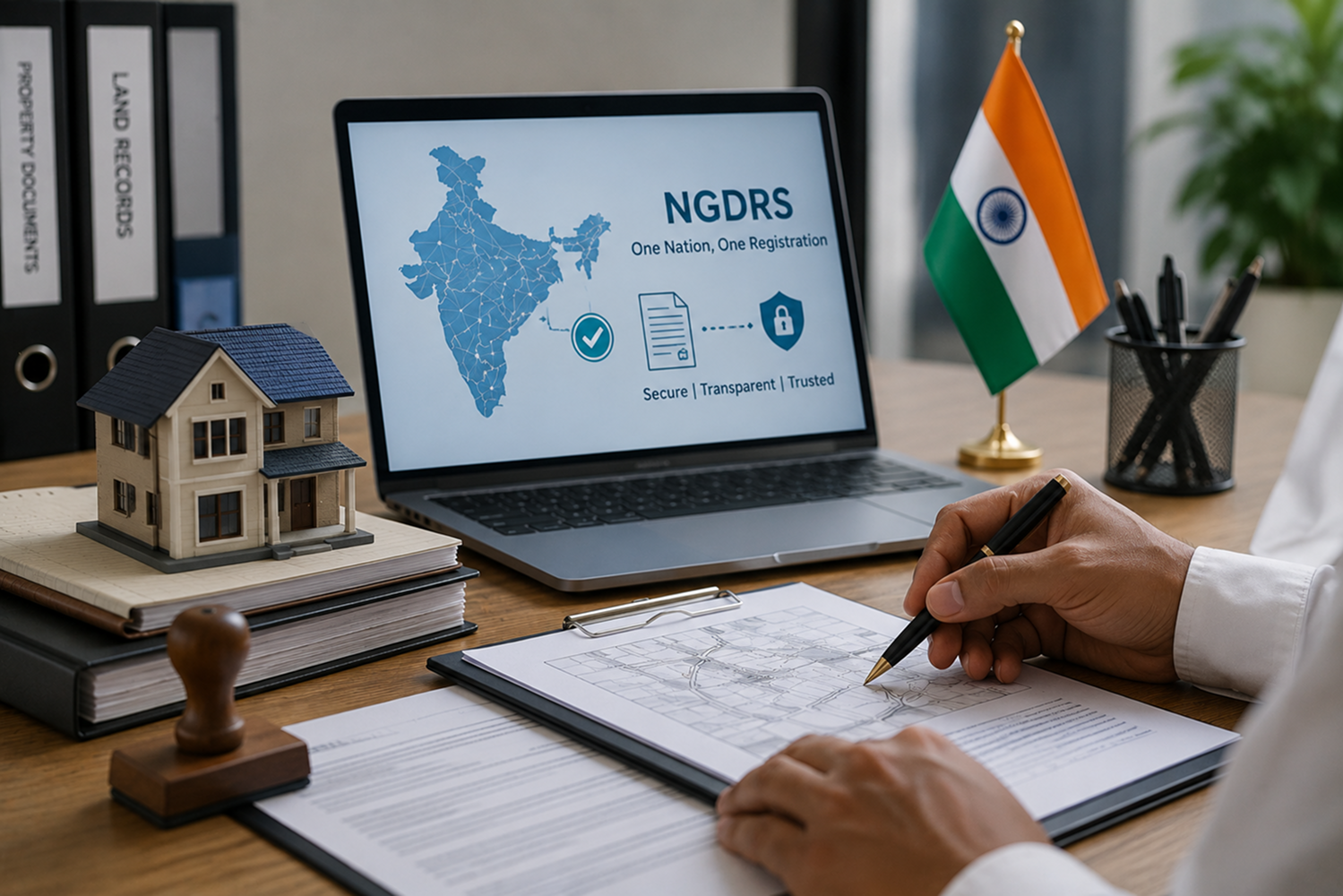
For a long time, buying a home in India felt like navigating a maze in the dark. You’d find a beautiful property, agree on a price, and apply for a Home Loan, only to discover that the “owner” had already sold the same plot to three other people, or that the paper records at the local registrar’s office were mysteriously “missing.”
In 2026, the lights have been turned on. The National Generic Document Registration System (NGDRS)—better known as the “One Nation, One Registration” initiative—is fundamentally changing how property is bought, sold, and financed in India.
Whether you are a first-time buyer or looking to leverage your existing assets with a Loan Against Property, NGDRS is the digital shield you’ve been waiting for. Here is everything you need to know about this revolution.
1. What is NGDRS? The Unified Digital Blueprint
The NGDRS is a centralized, cloud-based software developed by the Government of India to standardize property registration across all states. Before this, every state had its own (often manual) system, making it nearly impossible to track property history across borders.
The “One Nation, One Registration” Vision:
- Standardization: Whether you are registering a flat in Mumbai or land in Ranchi, the interface and process remain uniform.
- Transparency: Citizens can access property valuation, calculate stamp duty, and check for encumbrances (existing loans or legal disputes) online.
- Efficiency: Physical visits are minimized. You upload documents, pay fees, and book appointments from your smartphone.
2. Ending the Era of Property Fraud
Fraud has been the single biggest deterrent for home loan seekers. NGDRS addresses this through three “High-Tech” pillars:
A. Real-Time Linkage with Land Records
NGDRS is integrated with the digital land records of various states. When a seller tries to register a deed, the system automatically checks if they actually own the land. If the land is already “flagged” or sold, the transaction is blocked instantly.
B. Verification and Biometric Authentication
Gone are the days of “impersonation fraud” where a stranger could pose as the owner. Under NGDRS, both the buyer and seller must undergo biometric verification (fingerprint or iris scan) at the Sub-Registrar Office (SRO). This ensures that the person signing the deed is exactly who they claim to be.
C. Prevention of “Double Filing”
The system creates a unique “Document ID” for every transaction. If someone tries to register a second sale deed for the same property, the system alerts the registrar immediately. This eliminates the “Multiple Sales” scam that used to haunt the real estate sector.
3. Why Lenders Love NGDRS (And How it Benefits You)
When you apply for a Home Loan, the bank spends weeks on “Legal Technical Verification” (LTV). They have to send a lawyer to the registrar’s office to manually check physical books.
How NGDRS speeds up your loan approval:
- Instant Verification: Lenders can now verify property titles digitally, reducing the time for “Technical Approval” from 15 days to just 48 hours.
- Accurate Valuation: NGDRS provides rule-based valuation. This means the bank’s estimate and the government’s valuation are aligned, reducing the risk of your loan being rejected due to “under-valuation.”
- Encumbrance Transparency: Lenders can see if there is an existing Business Loan or mortgage against the property, preventing you from accidentally buying a “debt-ridden” asset.
4. Step-by-Step: Registering Your Property via NGDRS
If you are buying a home in 2026, here is the simplified journey:
- Citizen Registration: Create an account on your state’s NGDRS portal using your mobile number linked to your digital identity verification networks.
- Document Entry: Enter the property details (survey number, area, usage) and the “Market Value.”
- Valuation & Stamp Duty: The system calculates the exact stamp duty you owe. No more “hidden” bribes or agent fees.
- Online Payment: Pay the fees through a secure government gateway.
- Book an Appointment: Choose a 1-hour slot (like the new system in Gorakhpur) for the final biometric signing.
5. The Future: GIS Mapping and GPS-Linked Titles
The government is now moving toward GPS-linked property titles. In the near future, your NGDRS record will include exact satellite coordinates of your property. This will end “boundary disputes” forever, making Small Business Loans even easier to obtain for shopkeepers using their premises as collateral.
Conclusion: A Safer Path to Your Dream Home
The “One Nation, One Registration” system is more than just a software update; it is a promise of security. For home loan seekers, it means your investment is safe, your documentation is digital, and your title is indisputable.
At Credit Saison India, we are fully integrated with these modern digital frameworks. We use these tech-driven insights to provide faster, more transparent Home Loans to our customers.
Ready to secure your piece of India? Explore our Help Guides to learn more about the legalities of property buying in 2026, or check your eligibility for a loan today. Your dream home is now protected by the best of Indian technology.
Have you checked if your state is already live on the NGDRS portal?
Share On :
Popular Blogs

20th September, 2026
MSME Definition and Classification: What Size Business Qualifies for MSME Loan
Discover the MSME definition and classification to find if your business qualifies for an MSME loan. Learn about MSME eligibility and the differences between government and lender criteria.

14th September, 2026
Home Loan Processing Fees: An Essential Guide for Buyers
Discover what home loan processing fees cover, if they're refundable, and how they impact your loan. Trust Credit Saison India for clear upfront lending.
Share On :

Products
Download Credit Saison India App


Follow us on


Credit Saison India is the trade name of Kisetsu Saison Finance (India) Private Limited (CIN: U65999KA2018FTC113783), a non-banking finance company (NBFC) registered with the RBI.
Registered Office Address:
IndiQube Lexington Tower, First Floor, Tavarekere Main Rd, Tavarekere,
S.G. Palya, Bengaluru, Karnataka 560029
- Investors
- Partners
- Insurance Partners
- Collection Agency
- Regulatory
- CS Japan

- Saison International
- © Kisetsu Saison Finance (India) Private Limited 2026.
© Kisetsu Saison Finance (India) Private Limited 2026.